We no longer update this blog

For our CURRENT BLOG visit our website: http://www.gaiacreationsecoland.com/blog
________________________________________
Showing posts with label beneficial insects. Show all posts

Tuesday, August 2, 2011

An Elderberry Volunteers -Applying Permaculture Principle Number One in Our Backyard

Work With Nature Rather Than Against It: We can assist rather than impede natural elements, forces, pressures, processes, agencies, and evolutions.
Observe and Interact: By taking the time to engage with nature we can design solutions that suit our particular situation.

Elderberry volunteer 4-25-08
This beautiful California native shrub (photo above) is a volunteer plant.  He sprouted up a few years ago, probably from the seed of a passing bird, and staked his claim on what our family had planned to be a sunny Zone 2 herb garden… and we let him take over.  Once we did our due diligence of his habits and functions, that is.  What we found are shrubs like the native Elderberry (Sambucus mexicana) are insectary plants and provide pollen, nectar, shelter, as well as undisturbed habitat, for beneficial insect predators and parasites. 

Monday, June 13, 2011

From grass to habitat garden... our front yard 2005-2011

Our rural 1/3 acre of land in Northern California has been our home and office as well as a continual experiment in ecological land care and permaculture for over 6 years.  Our decision to relocate to the 'city' this month has us pondering just how much we've improved this particular piece of land in the short amount of time we've been here...  so I decided to take a journey back in time. 

Rope swing 2011
Unbeknown to us in 2005 we moved into a chemical dependent neighborhood; neighbors who rely on pest control companies, Round Up and weed/feed for regular property maintenance.  Within our own property we found enamel paint had been washed out on the back lawn and evidence of recent herbicide and pesticide spraying around our new house (pest company sticker in the garage with the date of application).  Gardening ecologically for a long time we have learned a lot about how to make the transition from a chemical dependent landscape to an organic and biologically based one and how to do it with little time and effort.

Wednesday, March 9, 2011

Spring Mulch on Site aka Chop and Drop Mulching

It’s important to consider our unique Mediterranean climate this particular time of year. Getting a basic understanding of how our seasons, the hydrologic cycle and your gardens all interact is not only fascinating but essential for healthy plants and soil life.

chop and drop wheat and other grasses for green mulch
 
Precipitation exceeds evaporation in the Spring*.  Air and soil temperatures gradually rise with increasing daylight hours, critters become more active, plants begin to grow again and everyone thrives with the moisture and additional warmth of early Spring.  How we can utilize this seasonal activity to our benefit and ultimately the health of the whole landscape? 

Mulch-on-Site 
aka Chop and Drop mulching

Friday, November 12, 2010

Forest Gardening Tips AUTUMN


look closely, can you see the mantid egg sac?
Avoid dead heading all your flowers and shrubs.  There are many insects who have made use of your plants for their next generation... see photo above of praying mantid egg sac.

DO NOT BURN YOUR LEAVES!  Don't burn healthy wood debris either; shred it or leave it out for solitary bees and other beneficial insects.

Plant woody plants (trees, shrubs, groundcovers) after dormancy yet before the ground is too wet.

Ensure irrigation is functioning on an as needed basis. *Contact us to install a Rain Sensor.

you can see the egg sac pretty well here
Apply heavy mulches before your first Fall frost date (here); especially to marginally hardy plants.   Avoid crown rot with too much mulch on sensitive plants.

Build mulch stockpiles after you've spread out all you can.  Allow it to compost or use the extra mulch sporadically. 

Monday, November 1, 2010

Late Autumn Bloomers

A beneficial insects' dream...

Salvia greggii
Insects are busy now ensuring their eggs have been laid and their burrows and hide away's are secure and fully stocked.  They are out in the last rays of warm sunshine gathering the nectar and pollen from flowers that bloom into November's darkening days.

We too are feeling the slow down of summer's many harvests and one look to the pantry shows our storage efforts have paid off.  Yet there is more to think about in the garden...

We can aid the health of our gardens and next year's bounty by encouraging beneficial insects to stay around.  Providing them food during the winter by planting late blooming flowers will help the insects that don't hibernate or have yet to.  

In our region it gets cold but it doesn't truly feel like Winter until late January.  Plants like Salvia greggii (pictured above) will bloom well past Christmas with no major frost. 

Thursday, August 5, 2010

Dragonflies and Damselflies


Both dragonflies and damselflies are considered a gardener's friend as they eat mosquitoes and other flying pests.  They require a source of water if you want them to stick around year after year; and it can take them a long time to mature!  Some spend as long as five years in the aquatic larval stage (eating mosquito larvae then too!).

While the images here are less than wonderful quality one gets the understanding of the diverse patterns and shapes dragonflies and damselflies take on.   

Quite a magical sight on a summers evening watching them dip and dive...


Thursday, July 1, 2010

To honor our pollinating friends here is a tidbit of trivia about...

Honey Bees

There are three types of Honey Bees in the hive...

Worker, Queen and Drone

Worker bees are all female and make up about 85% of hive bees.  Workers gather flower nectar and pollen; the pollen they carry in special pollen "baskets" on their hind legs.  Pollen provides the colony with vital amino acids, vitamins, fats and the enzymes necessary for making honey.  Workers also decide which bees in the hive will become queens.

The males or drones have one purpose in life: to mate with the queen; but there are distinct disadvantages to being a male.  When food supplies are low or before Winter, workers may kick drones out of the nest.  Worse yet, if a drone is so lucky as to mate with a queen he dies immediately after.  What a life...

Honey Bee Fun Facts:
  • Bees do not create honey; they are actually improving upon a plant product, nectar. The honey we eat is nectar that bees have repeatedly regurgitated and dehydrated
  • The term "honey moon" originated with the ancient Norse practice of consuming large quantities of Mead during the first month of a marriage.  Mead is a fermented beverage made from honey.
  • Honeybees are the only bees that die after they sting
  • Bees can recognize individual human faces (We really believe this, our sons rescue 1000's of bees and never get stung -the bees know them!)
  • Honeybees never sleep!
For more information on bees and their benefits to our gardens and our planet visit this excellent (external) website.

Wednesday, May 12, 2010

Golden Treasures of Spring

The golden, oval dots pictured above are ladybug eggs. This ladybug knew what she was doing! Laying her eggs right next to a food source (red aphids) is a choice place for the eggs to hatch. In 4-10 days these babies will find a real sweet meal!

The larval phase of the ladybug lifecycle is the most voracious feeding stage of all. Known to eat as many as 400 aphids before they pupate ladybug larvae (pictured below) do a fine job keeping aphids and other garden pests at bay.

2 Fun Facts about Ladybugs:
  • In the lifetime of a single adult ladybug, over 5000 aphids will have been consumed.
  • One ladybug can lay up to 1000 eggs in her lifetime.
 Thank you Gaia!

Tuesday, November 3, 2009

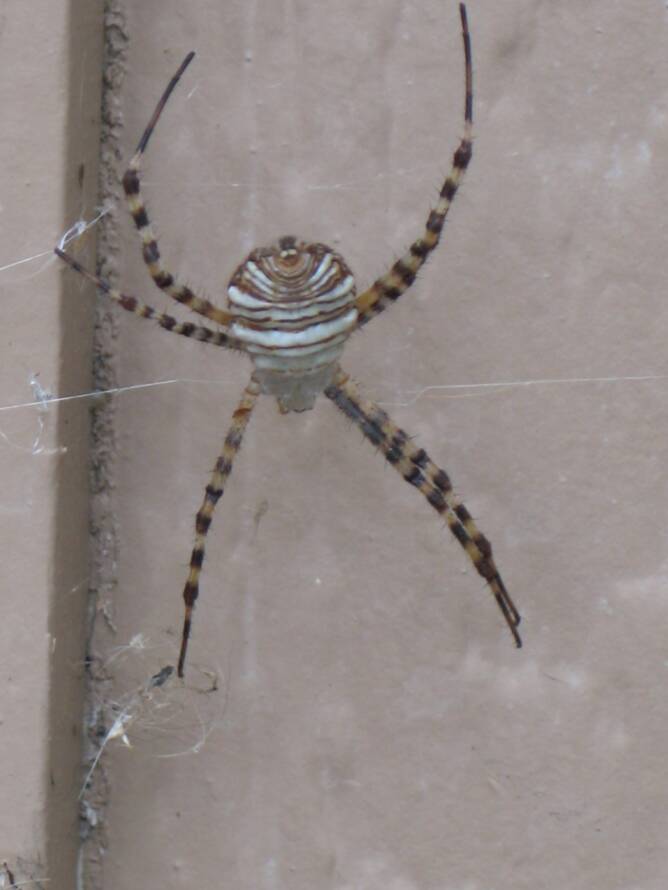
Beneficial Insects: Spiders


Two banded spiders with two totally different lifestyles...
Pictured above is the large banded garden spider, Argiope trifasciata. This type of spider is an ORB weaver, spinning their webs into circles commonly seen in gardens.
Below is pictured the hunting white-banded crab spider, Misumenoides formosipes. A predator with no web spinning abilities it attacks its prey, hopefully a garden pest!
While they both look kind of strange and creepy neither one of them is dangerous; to humans that is...

Wednesday, April 1, 2009

Akebia and Elderberry

Native Plant with Multiple Functions

Elderberry: Sambucus mexicana is our local Elder Tree.   At least six (6) useful attributes with only one plant!

•  Tall tree-like shrub provides shade decreasing ambient temperatures
•  Flowers provide insects with pollen and nectar
•  Berries provide humans and wildlife with food
•  Wood can be used for making arrows (as Maidu Native Americans still do)
•  Autumn leaves and branches provide food for the soil;  imperative for all of Nature’s cycles

don’t forget…

•  Absorbs carbon dioxide from the atmosphere while releasing oxygen back out!


Akebia quinata

Akebia quinata is a deciduous climbing vine growing to 36’ at a fast rate.  A native to China, Korea, and Japan it flowers in clusters of fragrant purple from April to May while the large seedpods ripen from September to October. 

Ideal for food forests or container gardening!  It grows well trained as a ‘living wall’ on North, East or West facing walls.  Ensure watering does not encourage spread as it can become a rampant if left to grow near riparian areas.  The dense mat of vines can displace native understory species.

USES: Akebia quinata fruit has a delicate flavor and a soft, juicy texture while the peeled stems are very pliable and can be used in basket making.


Thursday, May 1, 2008

BENEFICIAL INSECTS

Planting insectary plants into the garden will bring these predators and pollinators to your gardens.  Eliminating pesticides and harmful chemicals is also necessary.

soldier beetle

hoverfly

ladybug

aphid mummy caused by parasitic wasp
crab spider

garden spider

butterfly

lacewing eggs

ladybug eggs next to aphids

ladybug larvae

ladybug

Friday, June 1, 2007

CRAB SPIDER FEEDING

This underrepresented beneficial arachnid from the Family Thomisidae is eating a plant feeding insect we don't want in our gardens!  These particular families of spiders also have members the same color yellow as the Rose pictured here and can really be a remarkable discovery.


Sunday, April 1, 2007

THEY'RE BACK!!!!!

Aphids are probably THE most hated garden pest.  They make the plants unsightly not to mention sick-ER!  Most plants have pest problems because they are already weakened or compromised somehow. 

A proper balance of soil microorganisms is the key to healthy plants!  Habitat for beneficial insects like Ladybugs (or Ladybird beetles) is also crucial to keeping pest populations in check.  An environment free of pesticides will help bring in the beneficials to the landscape and is imperative for the whole system to thrive!